




Community PlanIt Makes TownHall meetings More Bearable
Community planning meetings are often times an unpleasant experience for any potential attendees. Participants occasionally have to deal with long-winded formal proceedings, dull meetings and repetitive discussion points just to put forth their personal inputs on key issues. In short, this traditional form of civic planning can be a rather inefficient and tedious process, which discourages local residents from actual engagement.
Now, what if there was a way to make civic planning not only simpler to participate but engaging as well? Designed by the Engagement Game Lab at Emerson College (one of many labs across the US), Community PlanIt is a game that aims to get local citizens more involved with community planning.
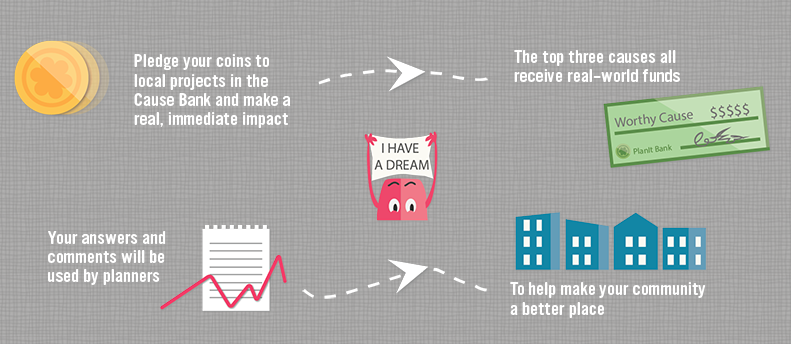
The game begins when a planning commission or small business donates a few hundred dollars to serve as a community investment with three central themes in mind. These three themes would then act as “missions”, containing challenges for registered users to complete. As users complete the challenges, they are given virtual coins which serves as in game currency to “fund” project ideas which they themselves feel would have the largest impact on the community. Once time is up, the three project ideas with the largest amount of pledged coins will be awarded with actual money.
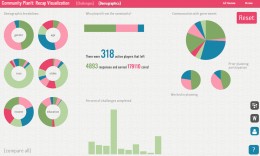
Community PlanIt’s most recent project was successfully executed in collaboration with the University/SouthWest (USW) district of Philadelphia, involving nearly 900 participants. Challenges such as uploading photos or videos to describe street corner improvements encouraged user dialogue as well as obtaining a diverse array of opinions. While the impact from the USW project is still be analyzed, previous games has shown how the Community PlanIt encouraged greater engagement and participation. 58% of the 4000 participants from Salem, Massachusetts game and 70% of 1000 Detroit game participants stated they would not have normally attended civic meetings.
One of the most exciting pieces of data was that about half of the users were under 18 years old. Eric Gordon, who leads Engagement Game Lab comments to FastCompany: “This is their first introduction to anything to do with civic engagement. [The youth] provide really meaningful input into these issues. And not only that, they also tend to motivate the adults.”
Gordon also added that not only the platform serves as a means to educate both young and old on local issues, they are able to gain valuable feedback from local residents who have to experience these issues on a daily basis, which deepens the community dialogue.
The efforts of Emerson Engagement Lab in designing such an interactive, engaging system to resolve a long time complex process is exemplary. Designing and implementing gamification systems is just not a matter of making a fun game out to solve problems — it still needs to match the underlying needs of the users who are playing the game.
Community PlanIt succeeds because it makes it more accessible for users to contribute to their community, while providing organizations to quickly amass and quantify the collected data. To put it simply, it is not just about making games but how to make sense of existing ecosystems and how we can built complimentary systems to help answer the need of others.