


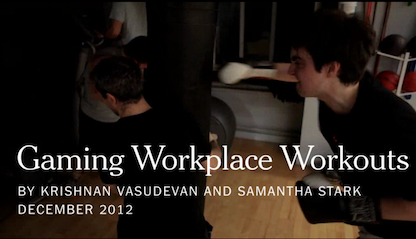
The NY Times Features Gamification And Employee Fitness

On Christmas Eve The New York Times –  the paper of record – acknowledged the influence of gamification with an article which features delightful game mechanics in its online version, while the print version of the article appeared on the cover, page A1. Technology writer Nick Wingfield offered readers a basic introduction to the gamification movement with some case studies and a little bit of cotroversy as well. Online readers earned badges for reading the article, searching through it, for reading the comments and more.

Read More

North Korea’s Crap Attempt at Gamified Propaganda: Pyongyang Racers

A Chinese company called Koryo Tours has been commissioned (or forced…who knows) to create a game simulating a driving tour around Pyongyang called Pyongyang Racers. You’re placed in a nondescript car and need to drive around this ghost-town of a city to collect oil barrels and stamps to see monuments in Pyongyang. After taking about  45 minutes to finish this crude game, I’ve come to the conclusion that Pyongyang Racers is one of the worst gamified marketing efforts I’ve ever seen.

Read More

The Evolution of Loyalty with Rajat Paharia

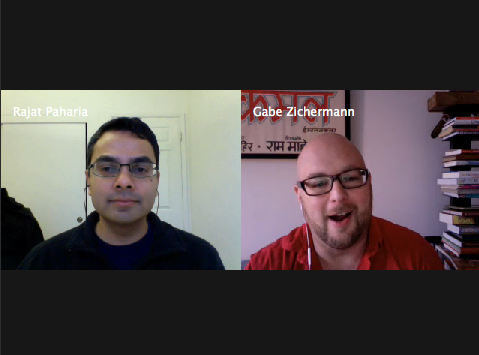
Each week on the Gamification Revolution web show, Gabe Zichermann answers all your burning gamification questions LIVE every Monday at 1pm ET/10am PT/1800 GMT at http://gamification.co/live. This week’s show features Rajat Paharia, Founder and Chief Product Officer of gamification platform, Bunchball. Here’s a rundown on some of the topics they spoke about:

  • What should people focus on first when starting to integrate gamification?
  • Why people fear personalized marketing and loyalty.
  • Rajat explains the “unfair value exchange” consumers are believed to have in gamification systems
  • Some examples of “negative” enterprise gamification
  • The current state of gamification in learning management systems


Download this episode (right click and save)

This will be our last episode of 2012 – so stay tuned for our return on January 11, 1:30 PM with Asi Burak, the Co-President of Games for Change.

Read More

Gamification Myths Part 2: Game Mechanics are Being Misused

One of the more vexing questions within game design is “what is a game mechanic” and its corollary — what isn’t. Along with some of the other major disagreements in game design, the mechanics question is both existential and crucial for understanding the interplay between games and gamification. Very long and interesting articles, papers, speeches and presentations (n.b. there are obviously thousands more) have been given on the topic of what is a game mechanic, how it works, what conflicts are, etc – most of them interesting, if academic.

Read More

Challenging Games for Change’s Designers and Gabe’s Gamification History

I see some issues that require immediate attention with the Games for Change world. Principally a rapidly emerging gap between the promise and the track record of socially-oriented gamified interventions. Why, with all the good intentions, is success so fleeting? And what can the high-minded practitioners in the industry do about making it better?

Read More

Gamification Myths: The Difference Between Game Design and Gamification

One of the biggest ideological debates in the games industry today is about the role, meaning, value and place of gamification. There has been almost every kind of discussion, from polite to threatening, political to academic and expert to amateur. And while the arguments and syntax vary, they seem to always end up in a place familiar to contemporary American culture: the religious ideological war. In fact, what we’re witnessing is more of a schism than an outright battle, and my sense is that both disciplines will ultimately be better for it.

In order to contextualize the discussion, I want to lay out the Top Four biggest mistakes, myths and misunderstandings that game designers have about gamification, and how they can improve their comprehension. At the same time, I want to help explain how gamification designers can benefit from accepting criticism through a meaningful filter that can be useful to advance the art and science of engagement.

Read More

Designer Jesse Schell Joins the Speaker List for GSummit SF 2013

In addition to big names such as Will Wright, Tim Kring, and Kevin Werbach, Jesse Schell has been announced to be a speaker at GSummit SF 2013, taking place this April 16 – 18. Jesse’s academic work in games has spawned The Art of Game Design and an enormous DICE talk featured on TED, to supplement his current work as a professor of Entertainment Technology at Carnegie Melon and as the CEO of his own design firm, Schell Games…

Read More

The Code of Gamification Ethics

For the last two years, I’ve been quietly talking about a gamification code of ethics. The discussion tends to come up most often at dinner parties and during GSummit, but it’s also been a hot topic during debates about gamification’s role in the future. I firmly believe that part of the reason we get so much snark online for Gamification is not because it’s a passing fad, but rather because it’s a powerful force for change that threatens the existing order. While we could dodge the question of gamification’s potential to cause harm to society, I don’t think we should.

That’s why I want to start a dialogue with the whole community about a code of ethics for our industry — and we need your involvement.

Read More

Gabe’s Gamification Revolution Featuring Richard Bartle

Each week on the Gamification Revolution web show, Gabe Zichermann answers all your burning gamification questions LIVE every Monday at 1pm ET/10am PT/1800 GMT. This week’s show features Richard Bartle, Visiting Professor at the University of Essex and the creator of the Bartle Player Types. Here’s a rundown on some of the topics they spoke about: Why we need to design for…

Read More

How Important is Story in Gamification?

Do you need story in gamification? Today’s edition of Gamasutra carried an interesting article about legendary game designer Shigeru Miyamoto’s opinion about the role of story in his upcoming game, Super Paper Mario. The gist is that consumers appear to favor great gameplay over deep narrative, leading the development team to question its raison d’etre….

Read More

Gabe’s Gamification Revolution with Richard Tate of HopeLab & Zamzee

Each week on the Gamification Revolution web show, Gabe Zichermann answers all your burning gamification questions LIVE every Monday at 1pm ET/10am PT/1800 GMT at http://www.gamification.co/gamification-revolution/. This week’s show features Richard Tate, VP of Communications & Marketing at HopeLab. Here’s a rundown on some of the topics they spoke about: Designing wellness game interventions that don’t talk down to young…

Read More