


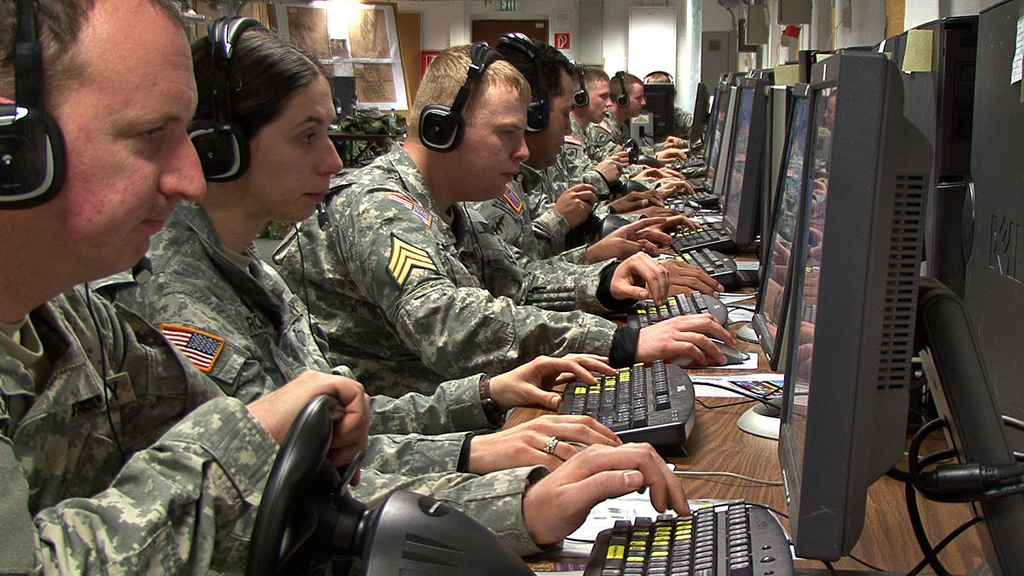
Turning Cyberwarfare into a Touch-Screen Game with Plan X

To quote the game series Fallout: “War. War never changes.” This may or may not be true to some people, but the Pentagon is at least trying to change cyberwarfare with Plan X.

Plan X is the Pentagon’s brainchild with made by the creators of some Apple products with assistance from the illustrators of the Transformers movies. The goal is to make cyberwarfare easy with a few finger swipes – a mechanism seen in many current casual games.

DARPA (Defense Advanced Research Projects Agency) is looking to take all the uncertainty and difficulty out of cyberwarfare. Currently there is too much planning, too many variables, and not enough control. The government wants cyberwarfare to be as simple and predictable as more classical means of war.

Read More

Farm Defenders is a Gates-Funded Training Game for Actual Farmers

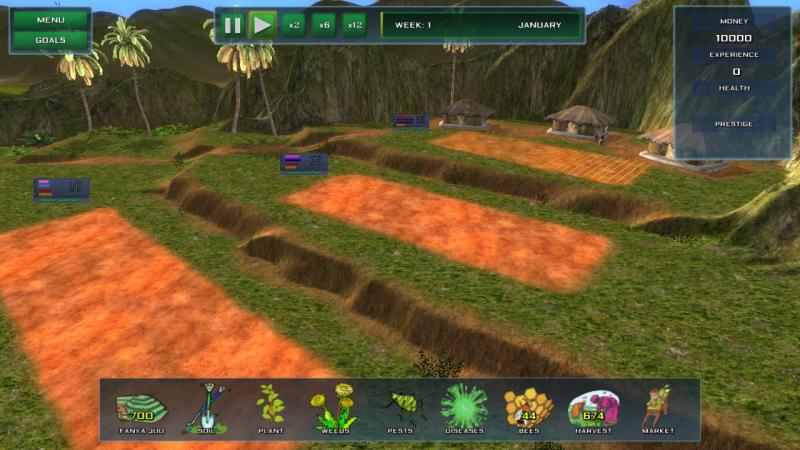
As the worldwide agricultural market becomes increasingly commoditized, the existence of a traditional farmer is becoming more and more scarce. However, many rural villages in Africa still require the skills of a trained farmer in order to support their local economy and community. We’ve reported on one community in Kyrgyz who has used a Farmville-esque game to support local farm operations but Fast Company reports on a new game supported by the Gates Foundation that aims to support these communities through learning. Farm Defenders is a hyperrealistic simulation training game that will be used as a tool for training extension workers, which are government-contracted consultants who teach villagers scientific knowledge through farming.

Read More

The George W. Bush Library Game Takes A Cue From Creationist Museum

Making waves among members of the gamification community last week was a video segment from “The Rachel Maddow Show” describing and condemning a gamified interactive exhibit at the recently opened George W. Bush Presidential Library. As demonstrated in the following video, the game “Decision Points” is designed to allow library visitors to experience what President Bush was going through while making the decision to invade Iraq in March 2003, using video segments and digitized multiple choice questions.

Read More

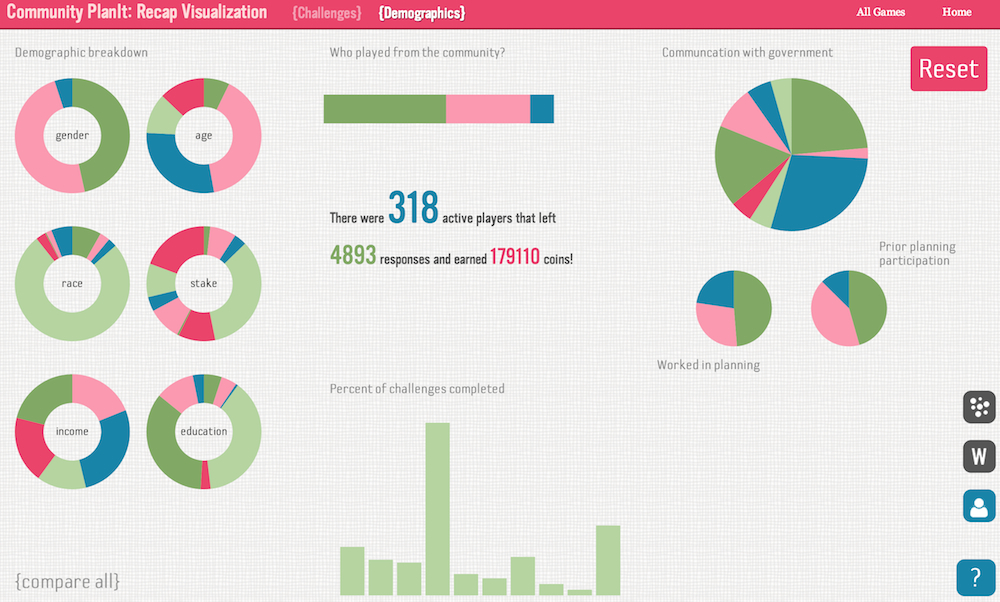
Boston CIO to Gamify Citizens Connect App to Thank City Workers

If the case for non-physical rewards (see SAPS) as a motivator still hasn’t convinced you of its effectiveness, you might want to look at Boston’s government mobile app that will allow Bostonians to improve city services.

Released in 2008, Citizen’s Connect allows local citizens to report issues like broken signs and potholes to make sure they are fixed quickly. According to SearchCIO, this effort is in part of Boston CIO, Bill Oates’ desire to create an active communication loop between citizen and workers to ensure city problems are solved.

Read More

How Companies Use Big Data & The Quantified Self Movement For Insight

The quantified self-movement (QS) is a hot topic in 2013 and focuses on using sensors and other trackers to acquire self-knowledge for the end goal of gaining deeper insight about personal habits. For example, I use Nike+ to log my daily run performance. I also make a list of my diet for that day and compare it to how well I performed. I am hoping that after a couple of months of use, I can figure out what the optimal diet is for me before I go for a run or engage in physical activities such as sports. Other examples can include measuring coffee intake vs. productivity or sleep activity vs. diet. With the inclusion of Big Data—the ability to process large amounts of data quickly—people are looking to contextualize all the data available on their laptops, mobile devices, or even social media platforms.

Whether or not you are actively participating in the QS movement, companies are adopting the method to find new ways to measure performance metrics. By measuring employee activity through sensors, these new metrics will be aggregated to redefine what being a successful worker means.

Read More

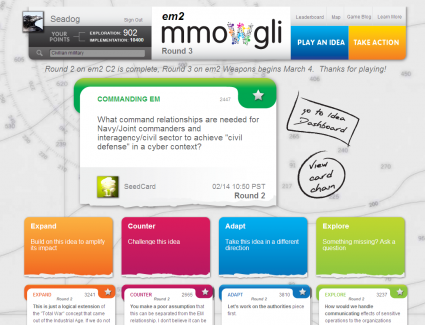
MMOWGLI: The Navy’s New Crowdsourced Ideation Game

What could the US Navy’s crazy acronym “MMOWGLI” possibly mean? – “Massively Multiplayer Online War Game Leveraging the Internet”

The acronym makes me picture an old Admiral with a monocole saying “Ah yes, we need to use the internets!” but the game is being used for more than just a little “war game”.

MMOWGLI is a new game by Office of Naval Research (ONR), Naval Postgraduate School (NPS) and Institute for the Future (IFTF) designed to crowdsource solutions for some of the Navy’s current problems.

Read More

Berliner Activists Introduce The Gamification of Anarchy: Camover

Why is it that the Europeans are the ones doing really cool shit with gamification? Here in the states it seems a new gamified app is released daily in the hopes of getting each of us to run a little bit faster, stay a bit more organized, get our kindergarteners to read more, or increase our personal sales goal (exponentially in many cases). We are each in a constant race to improve ourselves, and we’re doing it with applications and objectives that would make Mr. Rogers and the Elders in the Church of Latter Day Saints smile. It’s all so boring.

Europeans on the other hand tend to create quirky games to get citizens to obey the speed limit, decrease the rate of public urination, or promote safer sex practices in young people. They’re jogging on a steady sprint toward better conditions for society at large. These games tend to be fun, involve entire communities and take players away from their smart phones into an gamified reality. And when they don’t like what society is doing? Well then some decide to create a game to bring that society down.

Read More

Why China’s Propaganda Games Don’t Work

China has always viewed video games as a negative influence to society and the social order. In 2009, the Chinese Ministry of Culture banned mafia games, citing that these games embody antisocial behavior like killing, beating, and looting. China has not slowed down on its blacklisting of games, and they have even banned consoles such as the Playstation and Xbox. Contrary to what China’s past actions may infer, they have been actively investing millions of dollars to game companies in the form of grants and tax breaks. However, a new political move targeting the 120 million Chinese online gamers comes with some strings attached to these game developers.

Read More

Status in the Subway: Montreal STM Introduces VIP Program

Loyalty programs have been commonly associated with airlines and retailers but Montreal’s recent plans may soon change that perspective to include public transportation systems. Montreal operates the Opus-à-l’année also know as the Opus & Cie subscriptions, a subscription service which recharges a commuter’s OPUS card automatically every month.
Montreal STM will be introducing a VIP class for its customers, which will only be made available to 20,000 commuters (9% of the 217,000 who regularly buy monthly Société passes). After subscribing for more 12 months, Opus & Cie users will be given the opportunity to upgrade to their new “maestro” status.

Read More
millitary training

Military Simulation Game Training Improves Gaming Skills, Not Soldier Capabilities

It’s not very surprising that the military has been using video games as a form of training. This form of gamification is very serious, enough so that in 2008 the U.S. Army invested “$50 million over five years on games and gaming systems designed to prepare soldiers for combat.” This investment is so big, it has its own title: the Project Executive Office – Simulation Training and Instrumentation, or PEO – STI, and the Air Force, Navy, Marines, Coast Guard, and Homeland Defense are involved as well. These games are basically complex simulations, which have been in use since possibly the 1920’s.

Read More

North Korea’s Crap Attempt at Gamified Propaganda: Pyongyang Racers

A Chinese company called Koryo Tours has been commissioned (or forced…who knows) to create a game simulating a driving tour around Pyongyang called Pyongyang Racers. You’re placed in a nondescript car and need to drive around this ghost-town of a city to collect oil barrels and stamps to see monuments in Pyongyang. After taking about  45 minutes to finish this crude game, I’ve come to the conclusion that Pyongyang Racers is one of the worst gamified marketing efforts I’ve ever seen.

Read More

Family of Heroes Game Helps Soldiers and Families Cope with PTSD

The Department of Veteran Affairs estimates that between 11 and 20% of veterans of the Iraq and Afghanistan wars suffer from PTSD.  Yet many soldiers who suffer from PTSD are reluctant to seek help and their loved ones may not know how to encourage them to do so.  Some researchers are now using games in health as a strategy to get veterans the help they need. “Family of Heroes” by Kognito is an online simulation that helps equip families and friends of veterans to recognize symptoms of post-deployment stress and encourage veterans to seek help at the VA.

Read More